
Alamogordo City Directory Collections
Start at the Alamogordo Public Library. Skip any guesswork about which local volumes sit on its shelves. HeritageQuest opens a searchable city directory and county directory collection to cardholders. Access works from home or inside the building. The collection as a whole spans 1821 to 1989. That range describes the national archive. It is not a promise that every year, or any single publisher, is held for Alamogordo. Circulating genealogy books, in-library reference works, and local newspaper microfilm round out the holdings. Staff help ties it all together. For an Alamogordo resident lookup that stalls online, these routes give a practical path back to a shelf or reel.
| Historical source | Verified coverage | Where it is reached | Useful result |
|---|---|---|---|
| HeritageQuest city and county directories | 1821 to 1989, collection-wide | Library card access at home or access in the library | Name, address, or business lead; confirm that a local volume exists. |
| Library genealogy material | Local year run not published | Checkout and in-library reference at 920 Oregon Ave. | Family-history books and research aids. |
| Historical local newspapers | Titles and runs not published | Alamogordo Public Library microfilm | Notices, obituaries, social items, and address clues. |
| Federal population schedules | 1950 and earlier public census | National Archives and library genealogy channels | Household and selected address details. |
| Alamogordo business directory transcription | 1912 | Historical local genealogy context | A limited business and resident index example. |
No complete official finding aid lists the local shelf years. It also skips publishers, telephone-book runs, and newspaper titles. Bring a name, address, and rough year to the desk instead of guessing at a volume. Ask staff to check the catalog and holdings directly. The Alamogordo Public Library genealogy service answers questions before a visit.

The workstation is first come, first served. Reference assistance is part of the service path whenever an online result needs confirmation at the desk.
Alamogordo City Directory Desk Access
Reference Services sits at 920 Oregon Avenue in Alamogordo, reachable at 575-439-4148. A library card unlocks circulating genealogy material and remote HeritageQuest use. Reference items stay in the building. The genealogy computer also runs on a first-come basis. That split shapes the whole search. A patron can start a broad name search from home. Then come to the desk for material that cannot be checked out or has no online index. Ask by name for Alamogordo or Otero County directories, telephone books, obituaries, yearbooks, cemetery material, and newspapers. Give alternate spellings, initials, a spouse name, or a business name too. Any of these may be the exact form an old street directory used. Staff can point to genealogy quick links. A national collection never proves a local volume exists, though. The Library Collections page documents the genealogy material and the local newspaper microfilm.
Microfilm works as a companion source. A notice or obituary can place a family near the same date as a directory listing without making either record the final word on residency.
Alamogordo City Directory Home Access
HeritageQuest is the broadest digitized route for past residents of Alamogordo. The library offers access from home. An internet connection and a card number unlock it. Access also works inside the building. The directory collection holds more than 1.5 million records nationwide and spans 1821 to 1989. Around it sit census material, family-history books, and vital and civil registration resources. Cemetery indexes, probate and will pages, and maps are there too. Military and immigration records, plus obituaries, round out the set. Those numbers describe a national collection, not a continuous Alamogordo run. Begin with surname variants and a business name. Save the city, year, spelling, printed address, and occupation with each hit. When an entry appears, ask the library for help. A local volume, newspaper run, or reference work may confirm it. When nothing appears, the desk remains the fallback.
Reading an Alamogordo City Directory Entry
The 1912 Alamogordo business directory packs each line tight. A surname and given name, or a business name, opens the line, followed by an occupation, office, or role. Organization lines name an officer or proprietor. County-seat and railroad context fills the surrounding description, yet the lines themselves remain an index of people and firms, not a full household roll. Copy every initial and abbreviation exactly. Expand them only against another record.
| Name form | Record the surname, given name, initials, or business name exactly as printed. |
|---|---|
| Occupation or role | Use the stated work, office, or proprietor clue to distinguish similar names. |
| Address clue | Preserve any printed street form and number rather than silently changing it to a current address. |
| Business context | A business entry may name an officer or proprietor, not every person connected with it. |
| Absence from 1912 | The example is a business directory, so no listing cannot prove a person was not in town. |
Later volumes may add a street-order section or unfamiliar abbreviations. No local Alamogordo criss-cross volume or abbreviation key appears in the published library material. Check the front matter of any volume before trusting its shorthand.
- Criss-cross directory
- A directory arranged by street and number instead of by name. It is useful only when that portion is actually present in a volume.
- Householder index
- A name-based list of households. It is not the same thing as a full population list unless the source says so.
- Abbreviation key
- The volume's explanation of shortened terms. Photograph or copy it before interpreting a line.
Alamogordo City Directories and Street Names
Street wording carries real weight in an Alamogordo city directory. The town was founded in 1898 as the El Paso and Northeastern Railroad arrived. The original grid gave numerical names to east-west streets and state names to north-south streets. Today's White Sands Boulevard was once Pennsylvania Avenue. Record an older entry exactly as printed. Then bridge it to the modern boulevard only when the source date and location support that leap. The original core sat roughly within Indian Wells Road, Railroad Avenue, Third Street, and Washington Avenue. City material traces grid growth from 1898 to 1905. It also covers a 1942 range and base-era stretch. Major expansion followed in the 1950s. Those changes explain many addresses that refuse to fit a modern map. They never justify an invented address conversion. Consult the City of Alamogordo history when comparing historic and present street forms.
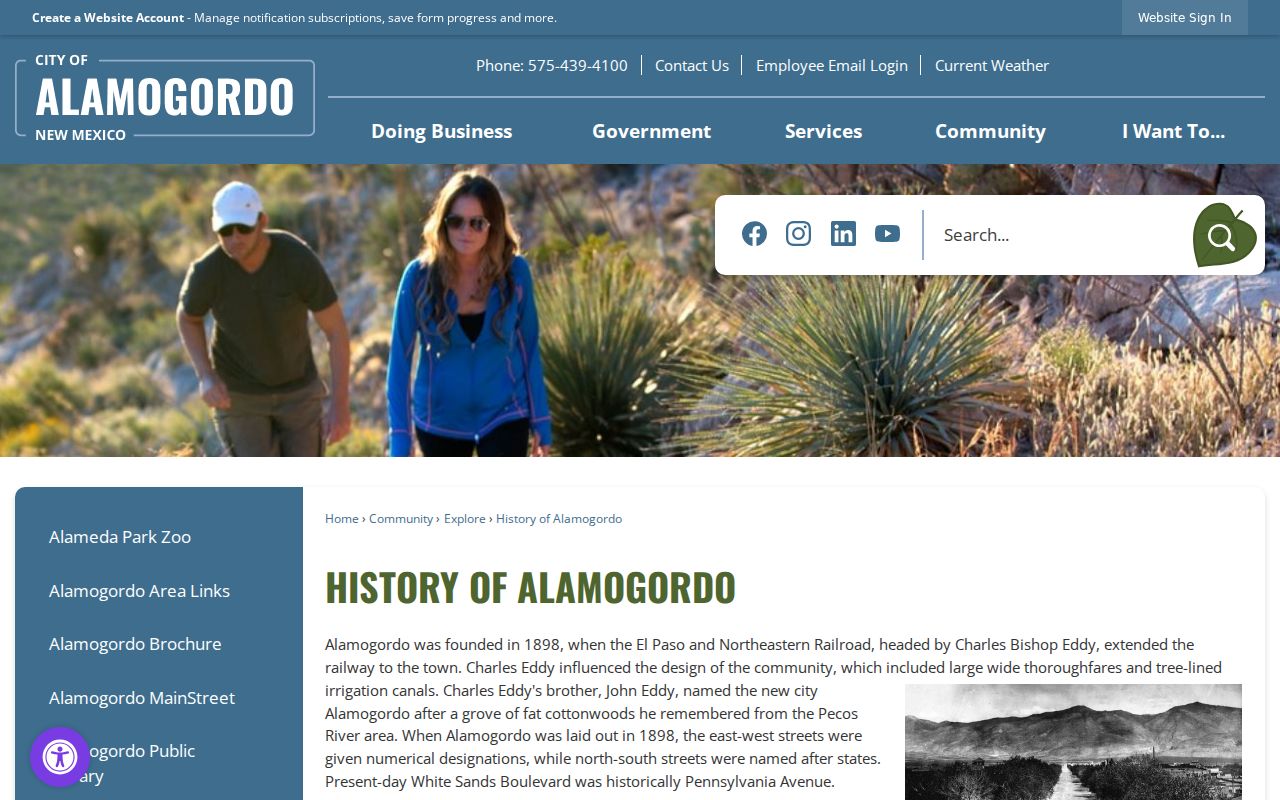
Old directory lines deserve gentle handling. Recording the source date, the street spelling, and the jurisdiction keeps an old entry from being forced into a modern postal format. Note: Pennsylvania Avenue and White Sands Boulevard are a documented local bridge, but no citywide renumbering or universal conversion ever took place.
Tracing an Alamogordo City Directory Household
Begin with the most recent address you trust. Then search the catalog and HeritageQuest for the surname, initials, spouse names, alternate spellings, and any business name. Check a second edition first. Publication timing, missed listings, and a changed street form can each make one year look conclusive when it is not.
- Record the directory year, city, printed address, name form, and every occupation or business clue.
- Search another edition for the same surname and address, including initials and spelling variants.
- Keep historical Pennsylvania Avenue separate from a current White Sands Boulevard note until the date supports the match.
- Compare the listing with a census from the same era for household members and other listed details.
- Use newspaper microfilm for life events, then use county property and recorded-document channels for the ownership layer.
Need a current address instead? The Alamogordo Street Directory is the modern route. It follows the map, assessor, and clerk paths, while historical directory work keeps its own dated trail rather than assuming a current owner was the past occupant.
Alamogordo City Directory Census Pairing
Directories rarely capture whole households. Federal census schedules fill that gap, and the National Archives makes the 1950 census and earlier public schedules available under the 72-year rule. Coverage varies by year. A census record can supply household members, ages, birthplaces, marital information, a street address, and other clues. Pair a directory date with a nearby census date. Neither is a full timeline alone. The 1890 federal population census is largely lost, so a missing 1890 household reflects a known national gap rather than an Alamogordo omission.
| 1898 | Alamogordo was founded and the original street grid was laid out. |
|---|---|
| 1905 | City redevelopment material notes Sanborn map context; exact editions still require verification. |
| 1912 | A local business-directory transcription provides a limited example of names and businesses. |
| 1950 | The latest public federal census provides a household checkpoint under the 72-year rule. |
Use the National Archives census research page to reach the public census route.
A census is a dated snapshot. It can corroborate a directory entry without fixing an exact move date or proving uninterrupted residence.
Testing an Alamogordo City Directory Address
Maps test place, not people. A directory entry still identifies the person or business tied to the time, and a map can confirm the ground itself. City redevelopment material cites 1905 Sanborn maps to illustrate early growth near 10th Street and White Sands Boulevard. A Sanborn map shows whether a block or building existed and how it was configured. Editions vary, though. The Library of Congress catalog holds Sanborn sheets, so confirm city, date, edition, and sheet before calling any map a match.
Street names need the same caution. Preserve the original notation first. Then compare it against the original grid and later growth. A modern ZIP label can mislead. Old sources often predate expansion beyond the first town footprint, so a modern street match may mean nothing.
Gaps in Alamogordo City Directories
The Otero County historical society publishes no holdings page, finding aid, research schedule, or shelf list for local directory years. Local runs stay undocumented. Do not build on assumptions. A presumed publisher run, criss-cross section, telephone-book run, or cemetery database does not belong in a family file. The public library is the fallback. Its reference and genealogy service, workstation, HeritageQuest access, newspaper microfilm, and links to wider archival resources carry the work instead.
Note: A missing digital result can reflect an unindexed volume, a spelling variation, or a collection limit rather than a household that was never there.